Thursday, May 31, 2012

Jennie and Delaney and Maipu (whose pu?)


Our friends from Yosemite, Jennie and Delaney, also happen to be in South America.  In fact, they were traveling all over Patagonia the same time we were but, somehow, everywhere we went, we always missed each other by a day or so.  They are currently staying in Santiago, Chile with Delaney’s brother, who lives there, and decided to come over to Mendoza for a long weekend. It was great seeing familiar faces and being able to discuss exciting things like traveling, US politics and Yosemite Institute politics!


Delaney, Tamara and Dan at Hot Springs
We took a day trip to some hot springs in the foothills of the Andes. I guess we should have gone when it was warmer because there was a whole water park attached (closed due to cold weather), with lazy river and all!  However, it turned out to be a misty fall day, so it was nice hanging around in the warmth.

We took another day trip to a mountain town called Uspallata. Turns out, they filmed part of Seven Years in Tibet in this town. We all wondered why they just didn’t film in Tibet, but hey, we got to sit in a Café that Brad Pitt probably sat in. We rented bikes and explored a pre-Colombian smelting site, and then a little further, some Inca carvings. Uspallata also has poplar trees lining all the roads, and they were all turning yellow, along with the multicolored hills, it was a beautiful day.


Poplar trees


Next, we ventured out to Maipu, one of the wine regions surrounding Mendoza to rent bikes and tour some of the wineries.  It all sounds so peaceful; riding bikes in the wine country, but it is actually an amusing adventure.  First, you arrive at the bus stop that is crowded with gringos.  To ride Mendoza’s public buses you need either exact change or you need a rechargeable card.  For some reason the hostels do not tell the gringos this.  Dan and I are always doing our best to blend in and keep a low profile, and the obnoxious gringos on the bus make us cringe a little.  When the bus arrives, everyone piles in, and the clueless tourist looks at the change machine confusedly, while the bus driver rolls his eyes.  This must happen every day.  Both times we have been on this bus, Dan has swiped our card for several people as they hand him the pesos.  We actually make a little profit on this because they never have exact change.


Andes view from Maipu bodegas
Then the bus full of loud English speakers rattles down to Maipu, and the driver signals everyone (Gringos and other English speakers) to get off at Mr. Hugo Bikes.  This is not an actual bus stop. We don’t know if the driver gets a kick-back from Mr. Hugo, or if he’s just eager to get the loud gringos off his bus. Mr. Hugo’s is always busy.  As soon as you arrive, they pour you a plastic cup full of horrible jug wine while you wait for them to bring out bikes.  The bikes cost $8 to rent for the day, but the funny thing is, they don’t take down your name, they don’t keep your ID, nothing. Dan and I were debating just riding off back to city center to have an $8 bike for three months. I mean, we would give it back…

Bike Parking
Delaney, Dan, Tamara and Jenny at bodega Carinae
There is a beautiful sectioned off bike lane…which ends about 200 feet from Mr. Hugo's. Then you are on the shoulder of the narrow road with cars and semi-trucks whizzing by. It gets even more interesting after you have had a few glasses of wine. This does make the wineries accessible for people without their own transportation, and on a budget, and you get a workout at the same time. One of our favorite wineries was a good 45-minute pedal, each way. What a buzz-kill! Literally!


As you arrive back at Mr. Hugo’s at the end of the day they take your bike and hand you another plastic cup of the same awful grape juice.  Waiting for the bus to take us back to city center, you can see abandoned plastic cups all along the sidewalk.

It was sad to see our friends leave Mendoza but we will no doubt see them when we return to the states.


Tamara 
Historic smelting site

Pictographs


Us with some grape vines

Sunday, April 15, 2012

Life in Mendoza


Getting to Mendoza
Our plan from the start was to stay in Mendoza for an extended period in order to study Spanish.  Our immediate goals were to find an apartment, enroll in a Spanish school and find a hostel to stay in while we did our search.  When we arrived and found the hostel where we had reservations, we were pleasantly surprised.  In Buenos Aires, we stayed in a hostel that had okay rooms, but the rest of it just felt somewhat grimy and the bathrooms were smelly.  Here, in Mendoza, for the same price we had a nice room with a clean private bathroom.  The hostel was in a cute old house that had a beautiful garden courtyard area and a pool!  However, there is always a catch.

Fountains in Plaza Independencia
Fountain in Plaza Independencia
Mendoza is in a desert but you would not know it from walking around.  Every street is lined with large old trees each of which grows a next to, and receives water from, a 2-foot deep, irrigation ditch.  Water is released through these irrigation ditches once or twice a week in order to water the many thousands of these trees throughout the city.  When the water is shut off, and the water recedes, the ditches are left with water which becomes stagnant.  This must be where the mosquito breeding takes place.  At night, they would visit us in ridiculous numbers.  It was hot enough that we had to sleep with the windows open, but there were no screens, so the mosquitoes would enter in unrestricted clouds.  There finally came a night where we reached out limit.  At about 1 am we realized that there was no chance at sleep under the presiding conditions.   We sealed everything up and went on a mosquito-killing rampage. It was a team effort, we ran around the room armed with magazines using every method possible to kill them.  We learned they liked to hide in the folds of our backpacks so we would stand ready with our weapons before giving one of the packs a good kick and then do our best to be sure there were no survivors.  That night we slept very warm but we slept.  The next day we found another hostel, which, in many ways, was not as nice, but we had a private room with air conditioning and no mosquitoes.

Language School
We looked up the language school that Tamara’s friend Cody had recommended to us, and signed up for a week of “intensive” courses. This consisted of 4 hours of class a day, 5 days a week. The classes had about 4ish people in them, most classmates staying for a week before heading off to a new place. The classes were a bit unstructured, but they did give some good practice speaking.  After the first week, we decided that we liked the school.  We switched from every day classes to attending two afternoon classes per week.  This has allowed us to have more time to do other things throughout our days but still have some structured class time.

Apartment hunting
Our apartment
Apartment searching in another language can be amusing.  We decided that we did not want to spend much money but were willing to spend a little extra if we could find one with WiFi, an oven and air conditioning.
We were able to look at one apartment through a connection with the school. It was a nice enough place, but the location was not great and the living room had these two couches, which converted into the beds, and no oven. Then we met someone that worked at our hostel that had an apartment, which had everything we wanted and the price was right, but it felt a bit run down and dirty.
We started looking online and though the classifieds in the newspaper.  Using classifieds to find an apartment was a challenge for us.  We had to ask around to find out which of the eight or so newspapers we should use, translate the classified entries and call the numbers we found.  Talking on the phone is hard enough English, in Spanish its even worse.  We located a calling center and wrote out a rehearsed speech like “Hi, I’m interested in the apartment that is in Diario Uno [the big newspaper here].”  Tamara did the talking and after reciting her speech, the other person would say something rapidly in unintelligible Spanish and then hang up.  Dan would ask, “What did they say?” and Tamara would say, “I don’t know, I don’t think it’s available anymore.”  Either that or I was supposed to meet them somewhere.  I just didn't know.
Parque San Martin entrance gate
After a week of trial and error style apartment searching, we got an email back from a website called Mihouse.  A woman named Mercedes got back to us and through her, we were able to see two more apartments, and we really liked one of them, which we are now living in.
Lake in parque San Martin
It is very small but it is the only apartment we saw that had air conditioning, WiFi and an oven (which is essential for the baking enthusiast).  Other benefits include a nice BBQ in the backyard, which we are able to use and it is located only two miles from Parque San Martain.  This main city park, though a bit run down, is large and beautiful.  Some of its features include a lake with a row club where you can watch crew teams practice rowing back and forth along the lake.  There are also works of art throughout the park, which demonstrate a time in the past when the city was really prospering including beautiful statues and elaborate fountains.

Now what?


Since our only commitment is now Spanish class for a total of about 3 hours a week you might ask, “what do we do with the rest of your time?”  Here is a small list…

Spiral Staircase
  • Living two blocks away from the park allows us easy access to miles of unpaved running trails, of which we have taken full advantage.  
  • We spend a lot of time studying Spanish both at home on our own and we attend several evening, school-sponsored activities.  Some of these activities include weekly “intercambio” events where locals and foreigners alike get together to practice speaking.  These intercambios take place both at the school and at a bar where alcohol, we believe, makes it a bit easier to speak Spanish.  These activities are a great way to interact with locals so we are trying to make a point of going.  
  • In addition to being a great place to study Spanish Mendoza is also the wine capital of Argentina so we are doing our best to study this topic in great detail.  We have participated in a harvest, attended wine tastings and do as much research at home as possible.

Tamara with Nagrita (she found her way back to us)

Wednesday, March 28, 2012

Bariloche to Buenos Aires


We have been a bit busy lately and as a result have fallen a bit behind on our blog.  We meant to post this about 3 weeks ago.  Sorry for the delay. 

There was no direct bus from Pucon to Bariloche so a detour with a stop in San Martin de Los Andes was necessary. While in San Martin we were lucky enough to see a hip hop dance competition between local elementary and high school students and it was awesome!  We walked around and decided it looked exactly like Pucon.  And it rained. 

The next day we got on a bus to Bariloche.  Once off the bus, we quickly found “The Penthouse” hostel.  There is no sign for this hostel. The Lonely Planet directions said for us to, “find the tallest building off of the main square, take the elevator to the 10th floor and look for room 1004.”  As its name suggests it is a hostel located in an actual Penthouse suite.  The views were amazing from the hostels large floor to ceiling windows.  The first two days it rained (no, I’m not joking) and the forecast called for rain the remainder of the week.  Even though we both had been feeling pretty “hiked-out” at this point, we didn't want our total Bariloche experience to be in a hostel so we decided to do one more trek regardless of the weather.

View of Bariloche from our hostel
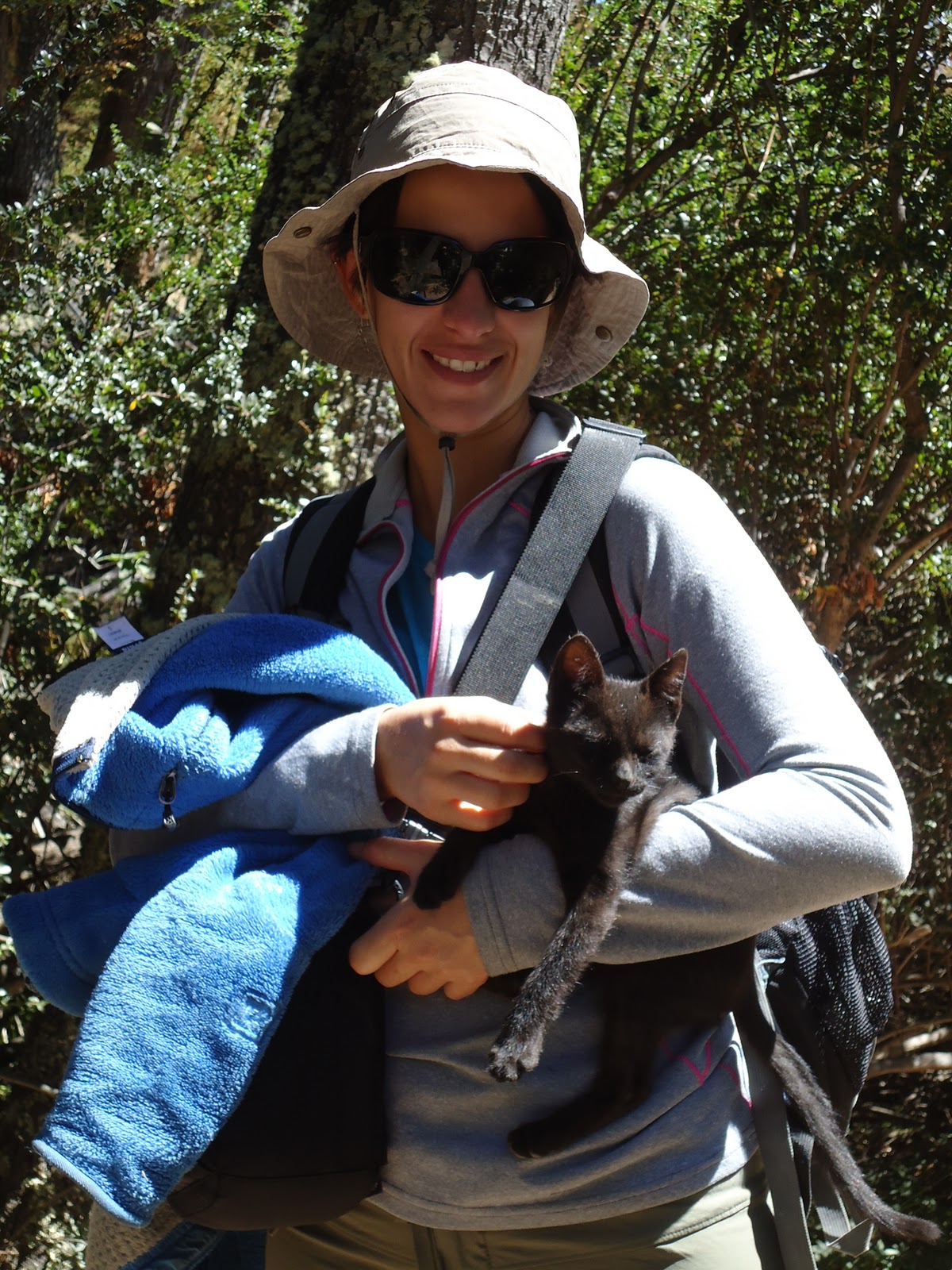
We caught a bus to a gigantic ski resort where we were joined by other tourists and workers who were making repairs and preparations for the rapidly approaching ski season.  This is also where the trail to Refugio Frey began, and after four hours of easy hiking we were there.  We are told it is a very famous Refugio as far as refugios go.  There are some amazing granite walls with only a short approach, which makes this a popular climber destination.  Frey is an old two-story stone hut on the edge of a lake that looks like it could have been taken right out of the Sierra Nevada mountains in California.  After setting up our tent we explored the refugio which we discovered, to Tamara’s delight, is kitten friendly.  We pulled Negrita out of her super secret backpack chamber so she could chill with the rest of us.  It was a small building with a woodburning stove for heat.  Next to the stove was a beanbag chair with a napping kitten we named “Gato Liquado”.  Negrita curled up with Gato Liquado and they became instant friends.  With mixed feelings, Negrita decided that Refugio Frey was the place for her and decided that she would stay behind and make it her home.
Refugio Frey

For the climbers: Right next to Refugio Frey

Negrita y Gato Liquado!


After some tears, we left Refugio Frey in search for Refugio Jakob.  According to the book, there was a simple trail to follow.  After being “temporarily misplaced” we finally found the trail, and we couldn’t believe that it was a trail at all.  No one ever built the trail.  Someone at some point found a way to cross the pass, straight up the mountain side, which became the trail.  It is marked with red circles and at times becomes 4th class climbing (all while wearing large backpacks).  After the summit we assumed that the slope would be more gradual for the downhill which, as it turned out, was not the case.  After the vertical hike and walking through a long, glacially carved valley, we realized we still had another pass to go over before the next refugio which turned out to be a repeat of the previous pass experience. Lonely Planet described this trek as “pass hopping through beautiful mountain scenery.”  Pass crawling and sliding was more like it but it was beautiful, no doubt.  The scenery made us feel like we were back home in Yosemite.  When we finally got to the bottom of the second pass and after we made our way through some foot-deep mud we arrived at Refugio Jakob. 
The view from the top. The trail went straight down from here
Pass number 1: The beginning of our "climbing" adventure


The view from Refugio Jakob
The next day we made our way back to the bus, which (we discovered) did not take money (apparently you were supposed to buy your ticket ahead of time) and we didn’t have tickets so we played dumb and got our ride for free.  We spent one more night at “The Penthouse” before catching a 20 hour bus back to Buenos Aires.  Taking advice from other travelers, we sprang for the “cama” class, which gives you a nice wide cushy chair that reclines 120 degrees, you get this leg rest thing, and they serve you meals! How luxurious! Almost all the long distance buses in Argentina and Chile are double-decker buses, so one mistake we made was to reserve the seats right in front of the windshield on the second floor.  We discovered it is better to be completely ignorant on how the driver is driving.  We spent two nights in BA (it rained hard) where we picked up the bag that Miguel and Flor were kind enough to hold on to for us. After spending the last two months wearing the same three sets of clothing, it was like Christmas when our wardrobe suddenly increased to five outfits. Eager to get to Mendoza we booked another 14-hour bus ride. 

Tuesday, March 6, 2012

Volcanoes and hot springs


From the Navimag Ferry, we headed north to the town of Pucón, Chile. Pucón is a town where the wealthy Chileans come to vacation, and it’s a beautiful town, but a little crowded and touristy. It’s right on a lake surrounded by tall mountains and volcanoes. One of the big attractions is to climb Volcan Villarica (9,341 ft). Since you need an ice axe and crampons to climb the volcano we went with a guide.


The scenery was amazing, you could see the town and lakes in the distance along with another, even larger, volcano.  We were climbing up an active volcano that constantly emits gasses so the guiding companies gave us each a gas mask in case the winds changed.  The interesting thing was that the guides had us leave our packs (with gas masks) below the summit and only bring layers and a camera. As we were slowly making our way to the summit the winds changed direction, and whatever vapors were coming out the volcano instantly made our sinuses and throats burn. Everyone in the group was coughing but it passed quickly. We both have been around other volcanically active areas. The vapors from this volcano did not smell like sulfur, which is stinky, but relatively harmless. These vapors smelled…deadly. We had few moments at the top to snap some photos. You could look directly into the crater and see the smoke coming out but more whiffs of the vapors made you want to get out of there quickly.

Coming down the volcano was the exciting part. The guides gave us a short (too short) lesson on glissading. For those of you not familiar with glissading, it’s a fancy French word for sliding on your butt or feet. You can use the ice axe to brake your speed, but neither of us has had much experience with this. The slides the guides told us to go down were these big long (water-slide looking) trench things in the snow. Sitting in one of these trenches, we assume the position and the girl in front of us goes. We can’t see much around the bend but her scream sounds like she was having fun! We were wrong.

Some of you may have experienced glissading out of control down a mountain and it is not fun. You are supposed to sit on your butt, knees bent, bottom of the ice axe digging in the snow to brake. Tamara went down and it was steep, too steep. She leaned on her ice axe, and there was no slowing down. She was digging her ice axe, heels, elbows, anything in the snow to slow down and nothing helped. Soon her feet were flailing around, and she was rotating side to side when the sides of the chute flattened out and she could see the other people in the group standing far below. She finally came to an abrupt stop at a snow bank, heart racing, hands shaking, terrified. Dan came down a moment later looking just slightly more graceful. There were about seven more of these slides to go to get down before reaching the bottom. It turned out the first one was the steepest and as we made our way down the mountain, the whole glissading thing got a lot easier and a lot more fun.

After we arrived safely down at the vans, we shared our disbelief that the guides take totally inexperienced people up and down that route every day.

The next day, still a little sore and bruised from our ascent, we set off on a 4 day trek in nearby Huerquehue (pronounced Where-kay-way) National Park. Compared to our experience in Torres Del Paine, it was like we had died and gone to another place. It was really our first time in about a month having sunny and warm weather and we got to hang out on a perfect summer day with our feet in a beautiful lake. The first campground was clean and quiet, and the scenery was reminiscent of the high Sierra but with more tropical looking plants. Our second campground and destination was located next to natural hot springs, which were glorious. We camped under some apple trees and soaked our tired muscles in varying pools of hot water. We were sad to leave, but just in time because the rain was coming yet again. 

Monday, February 27, 2012

I'm On A Boat!


When asked the question, “When do we need to be there?” the travel agent responded, “Now.”  That is how we started our adventure upon the Navimag.  We ordered the tickets online several weeks in advance.  The printed departure time on the tickets was 6am but in reality, as we found out, you need to check-in 12 hours in advance and sleep on the boat the night before departure.  After being informed of the correct check-in time we quickly ran to our hostel, pulled half-dry clothes off the line, packed our stuff, and ran for the terminal.  When we got there and finally made it through the long line and were able to talk to someone, we had had some time to think about the situation and I think our frustration was obvious.  They did upgrade us so we ended up getting a semi-private room with a window for half the price. 

The Navimag Ferry took us on a four day, three-night trip through the glacial fjords starting in Puerto Natales and ending in Puerto Montt.  Highlights included seeing dolphins breach the water, Bingo, having SNL’s “I’m On A Boat” stuck in our head for days, amazing views of mountains and glaciers meeting ocean, general relaxing and reading, and the food wasn’t bad either.  The lows would include running for check-in, Dan dropped and broke his point and shoot camera, possible bed bugs, horrible motions sickness and the coffee (Nescaf).


Tamara had an interesting side effect to the voyage. She had “landsickness” where she felt like the ground was moving.  We looked it up on the web and apparently this is a condition that some people don’t recover from for years. Luckily, after about four days of landsickness, it went away. Like most things in life, exercise fixed it. No more boats for Tamara. 

Saturday, February 18, 2012

Patagonia: The wettest dry place on Earth.


Due to internet issues, this entry was written about a week ago and we are just posting now. Hopefully we will have another one soon to bring everyone up to date.

We just got back from a crazy 10 day backpacking trip in Torres Del Paine National Park. 

We arrived in Torres Del Paine National Park with some pretty good weather.  We made it to our first campsite without too much trouble.  In December, a tourist accidentally started a fire in the park so the area is still recovering and many of the campsites are still closed.  Within the park you are only allowed to stay in designated campsites so open campgrounds absorbed all the extra campers from other closed campgrounds. Our first campsite was part of a tent city where tents were crammed into every possible open area. We found a sloped rocky spot to call our own (and felt lucky to have it).  The next day we hiked up a valley with some nice views of glaciers and peaks. We saw an amazing avalanche come down an entire mountain.  Then it started snowing on us, so we headed back to the tent city.

Day 2 at the campground was even more crowded than the first.  It was hard even to find room to put down our backpacks or find a spot to cook and people kept tripping over our tent’s guy lines.  For the hundreds of people there, there were only two toilets and two sinks to share. You had to wait in line to brush your teeth, fill up water or do your dishes. Then the winds came!

Tamara had put in earplugs earlier because of people staying up talking loudy.  We woke up with the tent hitting us in the head. The wind had ripped some of our stakes out of the ground and the tent was being blown flat, but luckily always popped back up. The winds must have been at least 60 miles per hour. Waves of dust also came into the tent covering everything, our sleeping bags, our hair, our eyes. There were people shouting, and the sound of the wind was terrifying. We can’t even describe the howling it made. Neither of us had ever experienced anything like it and it was relentless. If it wasn’t for the earplugs, Tamara wouldn’t have been able to sleep at all. Dan didn’t sleep much.  Through it all we thought to ourselves, “this is crazy but this must just be how it is here.”  The next morning we saw that part of the adjacent building had lost a small section of roof due to the winds. Many people’s tent poles had broken and collapsed and they were evacuated to a shelter.  Apparently, the staff saw that our tent was doing fine and decided not to bother us (Mountain Hardware makes good tents).

We learned that Patagonia is not dry like we had thought. In fact, it rains all the time, even when the sun is out, it’s still raining. We realized that in Patagonia it is always either raining, or the wind is blowing 30mph, so that you hike in zigzags all over the trail. Sometimes you get lucky and it does both. The 60mph winds are only a special treat that we experienced a couple times.

Day 4 we were feeling the effects of the bad weather, the weight of 7 days worth of food and Dan was fighting off a cold so we were moving pretty slow.  We were traveling on a poorly marked section of trail when a pickup truck pulls up and we realize that we are actually hiking on an old road and that they can drive all the way to the next hut. “Great! We’re hiking on a (insert expletive) road.”  The truck pulls up and they ask if we want them to take our backpacks. They say they will drive them all the way to the hut, which was still another 4 hr hike. So we jump on the opportunity by quickly throwing our packs in the truck and we watch it drive off.  As the truck leaves, we become aware of the possibility that we may have just donated our packs to some unknown organization such as DODG (Darwinism Of Dumb Gringos).  All we had left on us was our money, passports, Negrita (our trail cat) and water bottle.  We hiked the next 3 hours feeling very light and having mixed feelings about the wisdom of our decision. We were relieved to find our backpacks waiting on the porch of the Refugio (campground).

Day 5 just poured, so we chose not to hike and spend the entire day in the tent, napping and reading.


Day 6 and 7 we were blessed with no rain and only a few blasts of 60mph winds. We even got to cook and eat dinner outside one night.  We celebrated when the sun finally came out until we discovered that when the sun comes out, so do the mosquitos.


Day 8 was already our most difficult day due to time and distance hiked.  We’re used to elevation gain from being in Yosemite but we were not prepared for the extra challenge mud would offer.  Since it had poured the night before, the trail was not solid ground. We tried for about 45 minutes hopping from stick to stick to solid piece of ground.  We quickly realized this method was not going to work if we were to make the next campground before dark.  So we put our gaiters on and tromped through ankle deep mud.  We were lucky as we got up and over the pass with minimal winds and rain and were amazed by the sight of the gigantic Glacier Grey.  We ended up hiking next to it all day, for miles. It was just amazing.


After the setbacks from illness (Tamara ended up catching Dan’s cold as well, but not as intensely) and weather we took two more days to do the trail than we had planned. We stretched our food out so we were pretty hungry, sore, abused, and not sorry to see Torres Del Paine go. Our pizza and beer that night were especially tasty.

Monday, January 30, 2012

Patagonia - not just a clothing brand.

Seeing the Andes from the window of our plane definetly got us excited to do some hiking. We were surprised by how closely the El Calafate climate resembles that of the east side of Sierra Nevada. In fact, the setting looks just like Bishop, CA but with bigger mountains.


The security for domestic flights is like it used to be in the US.  There is one person looking at all the luggage passing through the x-ray machine (no need to take your computer out, no need to take your shoes off or worry about liquids) and you walk through the metal detector.  If it goes off they pat you down and that is it. Easy!

The first thing we did after we got settled in El Calafate is sign up for a whirlwind tourist package to see Glacier Perito Moreno.  We caught a bus and then a boat to do a short glacier trek then back on a boat to a different lookout.  The glacier is amazingly huge. You can see the whole extent starting in the distand mountains and ending in a milky-green lake where it calves (gigantic chunks break off) frequently.  Amongst the glacier guides we had celebrity status being from Yosemite. They all talked about how they wanted to climb El Capitan and definitely treated us differently than the other people on the walk.


At the end of the tour they served the whole tour group Jameson Irish Whiskey on the "rocks" (crushed glacial ice).
On the trail back to the boat Tamara met a five week old cat which she named Negrita. She wanted to take her with us as a "travel cat."  She now lives in Tamara's backpack above her sleeping bag and next to her sleeping pad.  It hasn't been a problem yet but we are a bit worried about traveling though Chilean customs.


Next, we took a bus to El Chalten, a town inside of Parque Nacional Los Glaciares, where the spires of Fitz Roy tower over the town. Our friend from Yosemite, Jon Jon, was supposed to be somewhere in the town, but he didn't have good internet access, so we arrived regretting that we had not kept in better contact. But the very next person we encountered walking down the street, was our tall gringo friend Jon Jon. I know its a small town but it was a pretty amazing coincidence. 


After making the appropriate preparations (Above, see Tamara shopping for essential backpacking food. Faty is actually the brand name of lard.) we set out on our four day backpacking trip near Fitz Roy which was kinda amazing.  The weather didn't fully cooperate with lots of rain and insane wind but we managed and it helped keep the crowds down.

Tamara with El Chalten in background

Mt. Fitz Roy

Tomorrow we are on a 8:30am bus headed to Puerto Natales, Chile.  From there we will spend the night before catching yet another bus headed to Torre del Pine National Park.  We hope to get in eight days of "treking" there before catching the NAVIMAG boat for a four day trip ending in Puerto Montt.